|
|
|
|
|
|
Comments: [video]https://www.youtube.com/watch?v=imiMUS4K7nk&ab_channel=Pavaraghi-tv2[/video]
Comments: China's Historic Dump of $53 Billion US Treasuries is Unprecedented Blow to US Economy (msn.com)
Comments: How sad have we become? 
Comments: WASHINGTON — Israel organized a campaign secretly targeting U.S. lawmakers and the American public with pro-Israel content through hundreds of fake social media accounts to build support amid its conflict against Hamas in Gaza, according to a New York Times report. The New York Times, citing unnamed officials and documents, reported that the campaign, which began last year, was commissioned by Israel’s Ministry of Diaspora Affairs, which connects Jews from other countries with the State of Israel. It remains active on X, formerly Twitter. Many of the posts were generated by ChatGPT, an artificial intelligence chatbot, and included content urging lawmakers to continue funding Israel’s military, according to the Times. Some of the lawmakers targeted include Rep. Hakeem Jeffries, D-N.Y., and Sen. Raphael Warnock, D-Ga.
Comments: Neoconservatives have been especially influential in the formulation of foreign and military policy, particularly in the administrations of Presidents Ronald Reagan, George H.W. Bush, and George W. Bush. They contend that power—military, economic, or political—that is unused is for all practical purposes wasted. The military might of the United States should be employed around the world to promote American interests. And it is in the interests of the United States, they say, to promote the development of democratic regimes abroad, in as much as democracies (according to the “democratic peace” hypothesis proposed by some political scientists) do not wage war against one another. Neoconservatives wish, in the words of Pres. Woodrow Wilson, to “make the world safe for democracy.” And indeed, neoconservatives often describe their views on foreign policy as “Wilsonian.” They view Wilson as an idealist who came to the Paris Peace Conference (1919) at Versailles with proposals for a just and lasting peace that were denigrated and defeated by cynical European politicians bent on punishing Germany for its role in starting World War I. Back in the United States, Wilson’s proposals for a League of Nations and for the country’s membership in that organization were defeated by isolationist politicians. The all-too-real result of such cynical anti-idealism was another and even bloodier second world war. Thus, idealism, far from being impractical, can produce politically practical and even admirable results. From the 1980s, neoconservative idealism took the form of an assertive and interventionist foreign policy that targeted anti-American regimes and leftist movements abroad. Sharp increases in U.S. military spending in the 1980s very nearly bankrupted the less affluent Soviet Union and helped to bring about its disintegration in 1991. Meanwhile, communist-led rebel movements in Latin America were crushed with the help of U.S. economic and military aid to regimes regarded as pro-American. In the George W. Bush administration, neoconservative officials in the Pentagon and the Department of State helped to plan and promote the Iraq War (2003). Critics contend that, for all their purported idealism and their talk about democracy, neoconservatives have been all too willing to prop up pro-American but deeply undemocratic regimes throughout the world. Jeane Kirkpatrick’s essay “Dictatorships and Double Standards” (1979), which made the neoconservative case for supporting pro-American dictatorships, was simply and unapologetically cynical, according to this perspective. Critics also take note of an apparent contradiction between neoconservatives’ views on domestic and foreign policy. With respect to domestic policy, neoconservatives are acutely aware of the possible unintended consequences of well-intended programs. But with respect to foreign policy, such skeptical awareness, according to critics, is almost entirely absent. In the months leading up to the Iraq War, for example, neoconservative planners seemed completely unaware that the invasion and occupation of Iraq might produce horrific consequences, such as large-scale sectarian violence and civil war. Such criticism has led some neoconservatives, such as Fukuyama and Michael Lind, to renounce neoconservatism and to become ardent and outspoken critics. Such criticisms notwithstanding, neoconservatism remains an influential ideology.
Comments: The U.S. government has over 750 military bases in at least 80 countries and deeply involves itself in all of the world’s major conflicts, most recently in Eastern Europe and the Middle East. But there have recently been notable calls for the U.S. to do even more. Following the death of Iranian President Ebrahim Raisi in a helicopter crash, both the Wall Street Journal editorial board and Yorktown Institute Senior Fellow Shay Khatiri, in separate articles, brazenly argued that the U.S. ought to help overthrow the Iranian regime. On the European front, American diplomat Victoria Nuland urged the government to help Ukraine strike inside Russian territory — and Biden recently announced that he will do just that. These calls for escalation in major geopolitical conflicts are consistent with our country’s enduring, hawkish status quo. But America urgently needs a foreign policy reckoning before our government catalyzes even worse geopolitical instability. Our interventionist foreign policy has not historically been a stabilizing force throughout the world, but rather has often served as a destabilizing wrecking ball, leading to harm overseas and at home. In the late 1970s and ’80s, the U.S. funneled money to rebels in Afghanistan, including Islamist extremists, to fight the Soviet Union. While those fighters expelled Russian influence, they later turned on each other. In the struggle for power, a number of those rebels ultimately formed the Taliban and al-Qaeda, who carried out the 9/11 attacks. Following 9/11, America spent over $8 trillion in taxpayer dollars on wars in the Middle East; lost thousand of troops and killed hundreds of thousands of civilians; and violated Americans’ Fourth Amendment rights by spying on their electronic communications. It is astonishing that some still want the U.S. to further meddle in the Middle East. Our country has already played kingmaker in Iran. We should not be seeking to do that again. In 1953, the U.S. helped overthrow the elected leader of Iran, Mohammad Mosaddegh, who opposed British oil companies operating in the country. The West feared Mosaddegh had Communist leanings that might push him to support the Soviets. Following the coup, the U.S. installed the Shah, a brutal dictator, because he was loyal to the West. Decades of the Shah’s repressive rule inspired hatred toward America that culminated in the Iran hostage crisis. A general uprising of Iranian citizens led to the Shah’s ouster; the government was then replaced by the theocratic Islamic Republic that some want the U.S. to overthrow today. America’s foreign policy establishment cares very little about democracy abroad. In their eyes, loyalty to the West trumps all. Instead of seeking to bring about more regime change in the Middle East, our leaders should heed the words of former Rep. Ron Paul, who said in 2008 that terrorists “don’t come here and attack us because we’re rich and we’re free. They come and they attack us because we’re over there.” The U.S. also played an integral role in the events that lead to the devastating war between Russia and Ukraine. Despite the fall of the Soviet Union, NATO endured and expanded eastward, which even George Kennan, one of the formulators of U.S. Cold War policy, warned would be “a tragic mistake” that would provoke “a bad reaction from Russia.” For over a decade now, against the warnings of former ambassador to Russia and current CIA Director William Burns, the U.S. has openly advocated for Ukrainian entry into NATO, a hard red line for Russia. Even though meddling in Ukraine was unacceptable to the Russians, the U.S. went as far as to support a coup to overthrow the elected president of Ukraine, Viktor Yanukovych, in 2014 after he announced that he would sign an economic deal with Russia instead of the E.U. This directly led to war between the two Eastern European nations. Then, according to NATO Secretary General Jens Stoltenberg, Russia sent NATO a draft treaty in 2021, requiring NATO to promise to abandon any future plans of expansion as a precondition to not invading Ukraine. The West refused. Only then did Russia invade. The invasion, while reprehensible, certainly did not come out of nowhere. Instead of continuing to send billions more to Ukraine and helping them strike inside Russian territory, the U.S. should reconsider its involvement in Eastern Europe altogether. Without American meddling, the current war — and all of the death and destruction it has brought — would likely never have occurred. Every day the United States tries to police the world. While doing so, the government tells Americans that our country is an unalloyed force for good on the global stage, fighting for democracy, making life better for the citizens of foreign nations and securing a safer world for all. This, we are told, justifies our hawkish stance and our proclivity to meddle in foreign affairs. But our track record flies in the face of these proclamations. American interventionism has led to needless death, destruction, geopolitical instability, increased animosity toward the West, wasted taxpayer dollars and the erosion of our citizen’s constitutional rights. The U.S. needs to reverse course immediately and adopt a noninterventionist foreign policy.
Comments: https://www.instagram.com/p/C7wzSSUqgHJ/?igsh=ZWhtMGRrY2plMjEw
Comments: I love this song https://youtu.be/VPYftS-kvYM?si=Xt-TShZQxDPxwEh2
Comments: Who likes instrumental? https://youtu.be/epniyt6IA_E?si=Aj4fg0DLpHyJfNCt
Comments: https://youtu.be/nXTtA5bKHrM?si=ZwfNKHbc_aEpCp16
Comments: Such a bipolar society america is ![[eek]](https://cdn.websitetoolbox.com/images/boards/smilies/eek.gif "Eek - :eek:") Listening to trump u would think he wants to throw all foreigners out. Not with this data ...
Comments: Happy to say that I stubbornly refused to provide my data to this survey. ![[tongue]](https://cdn.websitetoolbox.com/images/boards/smilies/tongue.gif "Tongue - :p") So, I am not in this survey. So, I am not in this survey.
Comments: And regardless of what idiot Trump and his even more stupid supporters say, here is the Brain Drain policy of the United States at work. About 70% of all PhD recipients stay in United states. The main reason: The rest of the world is shit. I wonder why! Iran used to be an exception, but they took care of that too. ![[kYaU1vi]](https://i.imgur.com/kYaU1vi.png)
Comments: And here is my favorite plot! Only 5.7% of all Science and Engineering occupations are taken up by US citizens. In S&E-related jobs the percentage jumps to a whopping 9%. ![[biggrin]](https://cdn.websitetoolbox.com/images/boards/smilies/biggrin.gif "Big Grin - :D") ![[1r6Xaw4]](https://i.imgur.com/1r6Xaw4.png)
Comments: And here is where STEM workers go, if they do not have a bachelor's degree. Hello rednecks. ![[gwzsJwQ]](https://i.imgur.com/gwzsJwQ.png)
Comments: ![[za5Indu]](https://i.imgur.com/za5Indu.png) Check out California. ![[rofl]](https://cdn.websitetoolbox.com/images/boards/smilies/rofl.gif "Rofl - :lol:") Greater than 75% of all workers are science or engineering workers. Greater than 75% of all workers are science or engineering workers.
Comments: انا الله و أنا اليه واژگون شهید نورالله نوری، شامگاه یکشنبه در حمله هوایی جنگندههای رژیمصهیونیستی به اطراف شهر حلب در شمال سوریه به شهادت رسید
Comments: Japan is back to it's glory days and a top5 team in the world right now. Iran actually played better today but the result was expected. Next Loss: Brazil on Wed. June 5 at 8PM PST [video]https://www.youtube.com/watch?v=rvc6kElejBU&t=402s[/video]
Comments: Iran volleyball keeps losing!
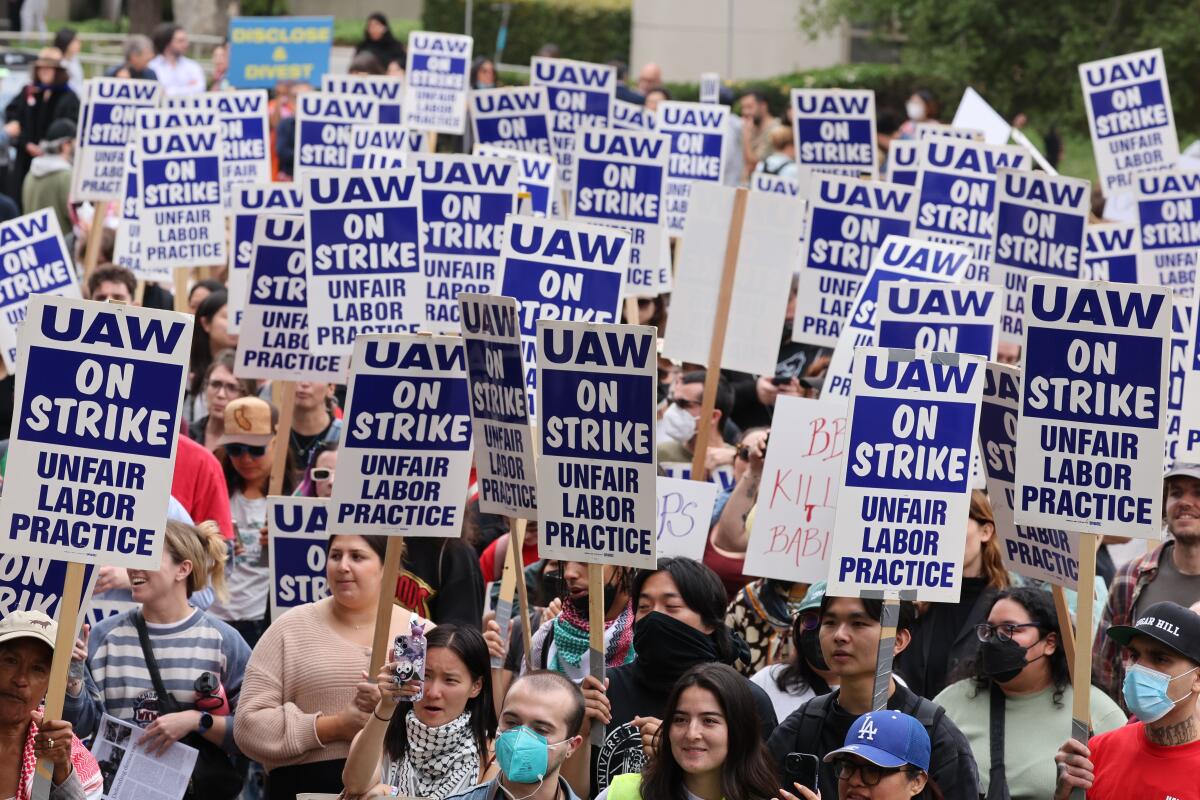
Comments: Maghsoud: UC strikes in support of campus protestors spread to six campuses. Denied again: UC fails a second time to get court order to stop academic workers’ strikeFor the second time, the state labor board has declined to order an immediate halt to the UC academic workers strike, which has resulted in canceled classes, blocked parking garages and disrupted coursework for thousands at a crucial time of the year when students take finals. The state’s Public Employment Relations Board ruled Monday that the university, in its legal filings, had not met the high legal standard of showing “irreparable harm” required for the labor board to approve an injunction. The walkout has included University of California campuses in Santa Cruz, Davis and Los Angeles. The strike expanded Monday to UC Santa Barbara and UC San Diego and is scheduled to spread Wednesday to UC Irvine. |
| < Previous 20 | Next 20 > |